About Newtons Ring Microscope
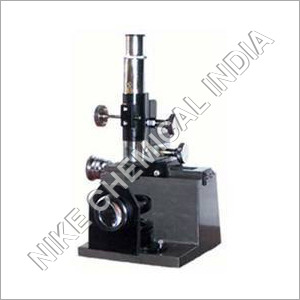
Newtons Ring Microscope
With the firm commitment to quality, we are able to manufacture, supply and export of Newtons Ring Microscope. This microscope is designed by a team of skilled workforce, using latest technology and techniques to provide qualitative output to clients. High grade raw materials are used in the manufacturing process, obtained from dependable sources of the market. To ensure zero-defect, this microscope is duly tested on various set parameters by a team of quality controllers. Newtons Ring Microscope is widely used in various laboratories.
Other information:
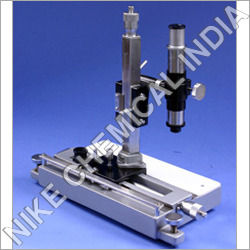
A compact instrument containing all necessary arrangements required for conducting Newtons Ring experiment. A standard microscope unit giving 30x magnification is provided with a rotatable crossline. The movement of saddle is achieved by graduated rotating drum, complete with Newtons Ring Set.
Unmatched Measuring PrecisionWith its high-accuracy micrometer and Vernier scale, the microscope can measure Newtons ring diameters to a resolution as fine as 0.001 mm. This level of precision is vital for laboratory experiments in optics, providing reliable, reproducible results every time. Both coarse and fine adjustments allow for meticulous focusing to optimize observation and data collection.
Robust and Laboratory-ReadyThe instruments heavy, anti-skid base ensures unwavering steadiness during operation. Its smooth sliding drawtube, rack and pinion focusing, and locking screw promote stable and clear ring observation. The stainless steel body resists wear and is easy to maintain, making it an excellent choice for frequent use in educational and research settings.
Enhanced Optical PerformanceEquipped with a plano-concave adjustable mirror and interchangeable achromatic lens mount, the microscope allows for superior light adjustment and optical clarity. The inclined monocular head and Huygenian or Ramsden eyepiece facilitate comfortable, single-user viewing, providing crisp, well-illuminated interference patterns.
FAQs of Newtons Ring Microscope:
Q: How does the Newtons Ring Microscope achieve precise measurement of ring diameters?
A: The Newtons Ring Microscope is equipped with a finely graduated micrometer scale and Vernier reading, offering measuring accuracy up to 0.001 mm. This setup allows users to measure the diameters of Newtons rings accurately, which is essential for optical experiments and calculations.
Q: What is the recommended process for setting up the microscope for observation?
A: Begin by placing the lens and glass plate on the large, stable stage. Use the rack and pinion mechanism for coarse adjustments, then fine-tune the focus using the precision micrometer. Adjust the plano-concave mirror to optimize illumination, typically from an external sodium lamp, to obtain clear interference patterns.
Q: When should the interchangeable objective lens mount be used?
A: The interchangeable mount is used when different magnifications or optical properties are required for observation. You can swap out the precision ground plano-convex lens as needed, ensuring optimal focus and clarity for various experimental setups.
Q: Where is this microscope primarily applied?
A: The Newtons Ring Microscope is designed for laboratory settings, especially in educational and research institutions. Its application centers on studying optical interference phenomena, such as Newtons rings, for physics and optics laboratories.
Q: What benefits does the anti-skid metallic base provide during usage?
A: The heavy metallic base with anti-skid rubber supports provides excellent stability during measurement and observation, reducing vibrations or movement. This ensures that the instrument remains steady, resulting in more reliable and accurate data collection.
Q: How do you optimize light adjustment for viewing Newtons rings clearly?
A: The tilting and rotatable plano-concave mirror can be precisely adjusted to direct external light, usually from a sodium lamp, onto the glass plate. This ensures maximum contrast and clarity when observing the interference patterns.
Q: What are the maintenance considerations for this optical instrument?
A: Routine maintenance includes keeping the lenses and glass plate clean, ensuring the drawtube moves smoothly, and storing the microscope in its foam-lined carrying case when not in use. Stainless steel construction makes it durable and simple to maintain for long-term, reliable operation.



 Send Inquiry




 Send Inquiry


