About Laboratory Sonometer
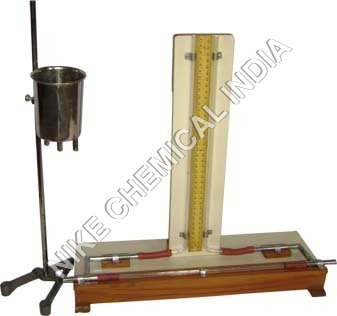
Recognized among the affluent manufacturers, exporters and suppliers of this domain, our firm is engaged in offering Laboratory Sonometer. The provided sonometer is ideal to investigate the motion and sound produced by adjusting the wire tension when it is plucked. This sonometer is manufactured by our adept professionals using topnotch quality raw materials and innovative techniques in conformance with international standards. Apart from this, we offer this Laboratory Sonometer to the clients at the most reasonable prices.
Features:
-
Easy to vary the density, tension and length of wire
-
Provided with slotted tension lever
-
Built-in scale and sound box
-
Easy to monitor frequency and amplitude at any point
Details:
Simple type model, it comprises a wooden board 700 x 90 mm (L x W) on four feet, fitted with two steel wires about 0.3mm x 1m (dia x length). At one end of base there are two 50 N spring balances with hooks and at the other end are two wrest pins.
Supplied complete with three bridges, one large, to span both wires and two small bridges for individual wires, two steel wires 0.3 mm dia. x 1 meter long.
Precision Measurement for Sound ExperimentsThis laboratory sonometer allows students and researchers to explore principles of sound by accurately measuring the frequency, tension, and density of vibrations. Its graduated scale and adjustable wire length (up to 1 meter) provide flexibility for various experimental setups, making it a trustworthy instrument in academic and research laboratories.
Sturdy, Reliable Bench-Top DesignThe sonometers rectangular, polished wooden box is crafted for stability and durability during repeated use. With rust-resistant metallic components and a smooth surface thats easy to clean, this physics lab equipment stands up to the demands of frequent handling while maintaining its professional appearance.
Simple, Manual Operation with Complete AccessoriesRequiring no electrical supply or batteries, the sonometer is operated manually using a straightforward tension-adjustment method. Each set includes calibrated weights, a pulley, and an instruction manual, ensuring immediate and hassle-free setup for experiments without any additional power requirements.
FAQs of Laboratory Sonometer:
Q: How do I use the laboratory sonometer to measure the frequency of a vibrating wire?
A: To measure frequency, stretch the steel wire between the fixed and movable bridges over the graduated scale, place a known load using the supplied calibrated weights, then adjust the wire length as needed. Pluck the wire and observe the resulting vibrations. You can calculate the frequency using the measured length, added mass, and sound equations provided in the manual.
Q: What is the maximum length of wire this sonometer can support?
A: The sonometer is designed to accommodate a steel wire up to 1 meter in length, providing versatility for a range of physics vibration experiments.
Q: When should I use the movable versus fixed bridge on the sonometer?
A: The movable bridge allows you to precisely adjust the vibrating length of the wire to suit different experiments, whereas the fixed bridge provides stable support for one end. Adjust the movable bridge according to the required wire length specified in your experiment.
Q: Where is the ideal place to set up and use this sonometer?
A: A stable laboratory workbench or table is ideal for using this sonometer, ensuring that the bench-top design remains steady during operation and delivers accurate experimental results without interference from external vibrations.
Q: What maintenance is required to keep this instrument in optimal condition?
A: Maintenance is straightforwardwipe the polished wooden surface and metallic parts regularly with a dry, soft cloth to prevent dust and corrosion. Store weights and accessories in the provided box. Avoid exposing the instrument to moisture to preserve its rust-resistant finish.
Q: What benefits does this sonometer offer for educational or research purposes?
A: The sonometers sturdy construction, adjustable wire length, and manual tension control provide hands-on experience for students and researchers investigating the concepts of tension, frequency, and sound propagation, supporting comprehensive understanding in physics education.



 Send Inquiry




 Send Inquiry


