About LINEAR EXPANSION APPARATUS
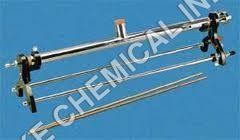
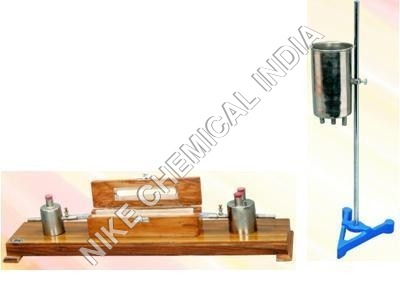
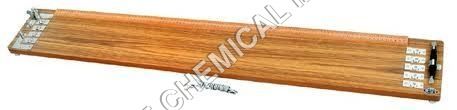
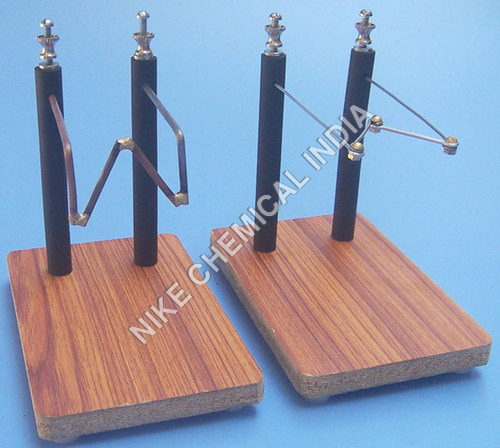
Designed with metal base and rollers, the provided Linear Expansion Apparatus is well-suited for students as well as professionals. This apparatus is used to determine the coefficient of linear expansion of all kinds of metals with extreme accuracy. This apparatus is precisely manufactured by our adept professionals using topnotch quality metal alloys and pioneering methodology in tune with international quality standards. Besides this, clients can purchase this Linear Expansion Apparatus from us at affordable prices.
Features:
-
Easy to use and maintain
-
Portable, compact and light weight design
-
High thermal conductivity
-
Corrosion resistance surface finish
Details:
Two cast metal legs joined together by a pair of plated metal rods, with each leg having provision for horizontally supporting the ends of plated brass tube about 50cm long. The tube has a riffled nozzle near each end, facing opposite each other for use as inlet and outlet of steam, and another outlet at the center with holed rubber bung for inserting thermometer to measure the inside temperature. The test rod is inserted in the brass tube supported in rubber bungs at its each end. At one end is fitted a micrometer screw head reading to 0.01 mm. A 4mm terminals provided on each leg for connecting an electric bell or galvanometer to indicate make/break of contacts. Supplied complete with 3 metal test rods, one each of copper, brass and steel.
Key Features and ConstructionBuilt with a robust metallic frame and support stand, this linear expansion apparatus accommodates rods of brass, copper, or steel, each approximately 40 cm in length. The measurement system uses a highly accurate micrometer screw and Vernier scale, delivering readings to 0.01 mm precision. The adjustable end fittings and interchangeable rods permit a variety of experiments, while heat-resistant knobs and insulated wires ensure safe use.
Versatile Heating and Measurement OptionsThe device provides flexibility in heating with options for an electric heater or a spirit lamp. With a power supply adaptable to 110V240V AC, the apparatus can heat rods up to 100C, enabling clear observation of linear expansion. The analog scale display is user-friendly, allowing students to record measurements effortlessly during laboratory sessions.
Application for Education and ResearchIdeal for physics laboratories across educational institutions, the apparatus supports hands-on learning and clear demonstrations of thermal expansion. Its precise calibration and durable build make it suitable for both classroom instruction and small-scale research work, contributing greatly to the understanding of material science among students.
FAQs of LINEAR EXPANSION APPARATUS:
Q: How is the linear expansion apparatus used in a laboratory setting?
A: The linear expansion apparatus is typically set up on a sturdy table. A selected rod (brass, copper, or steel) is placed between adjustable end fittings, then heated using either the inbuilt electric heater or a spirit lamp. As the rod expands, the resulting displacement is measured precisely on the micrometer or Vernier scale, allowing students to observe and calculate thermal expansion.
Q: What materials are provided with the apparatus for testing?
A: The apparatus is supplied with rods of three standard metals: brass, copper, and steel. These rods, each approximately 40 cm long, can be interchanged easily within the device to conduct comparative experiments on different metals rates of thermal expansion.
Q: When should the devices micrometer or Vernier scale be calibrated?
A: The micrometer is factory pre-calibrated and typically does not require recalibration before standard classroom use. If greater accuracy is required for advanced applications, users may verify calibration using a gauge block or standard reference before starting measurements.
Q: Where is this apparatus most effectively utilized?
A: The apparatus is best suited for physics laboratories in educational institutions, such as schools, colleges, and universities. It is ideal for both demonstrations during lectures and individual or group student experiments to study the physical properties of metals.
Q: What is the procedure for heating the rods safely?
A: Rods are heated by positioning them between the end fittings and selecting a heating methodeither switching on the electric heater (connected to AC mains) or using a spirit lamp placed strategically beneath the rod. Heat-resistant knobs and insulated wires should always be handled to avoid burns and ensure safety during operation.
Q: How does this apparatus benefit student learning?
A: By offering hands-on experience with real materials and direct observation of thermal expansion, the linear expansion apparatus enhances conceptual understanding. It encourages analytical thinking, precise measurement skills, and practical knowledge in material science and physics.



 Send Inquiry



 Send Inquiry


